
EconomyChinaElectronicsManufacturingHardwareHistoryShenzhen
From Fishing Village to Electronics Capital
Milinu TeamNovember 3, 202610 views
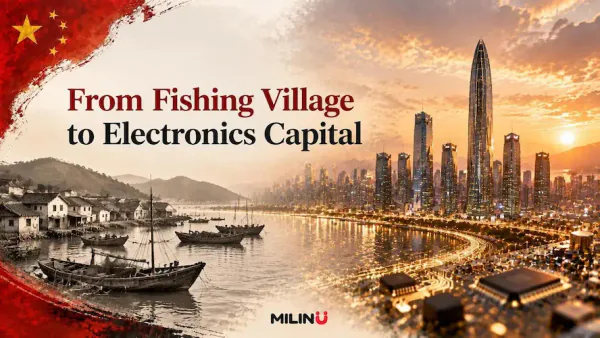
Shenzhen’s story is often told as a miracle. The real arc is clearer: a border town, a special economic zone, decades of manufacturing—and an electronics capital built on density and speed.
Shenzhen is now spoken of in the same breath as global technology. Phones, accessories, boards, and countless white-label devices pass through supply chains that touch this southern Chinese city. Yet a few decades ago it was mainly a small border settlement near Hong Kong—closer to fishing and cross-border trade than to semiconductors and smartphone assembly lines.
The jump from that past to an electronics capital was not magic. It was policy, geography, and a long accumulation of factories and suppliers.
The starting point
Before reform and opening, Shenzhen did not look like a tech metropolis. It sat on the edge of the mainland, next to Hong Kong, with limited industry by today’s standards. What it did have was location: a gateway position that would later matter when China decided to experiment with export-oriented growth.
That geography alone was not enough. Cities need rules and capital before workshops become an ecosystem.
The Special Economic Zone
In the early 1980s Shenzhen was designated a **Special Economic Zone (SEZ)**. The idea was practical: allow more flexible investment, foreign partnerships, and trade practices in a controlled area, and learn what worked for the wider economy.
For electronics, the SEZ mattered because it invited **processing and assembly**. Components could come in; labor, organization, and later local supply could turn them into finished or semi-finished goods for export. The city learned modern manufacturing under delivery pressure from international buyers.
From assembly lines to a full stack
The first wave was contract manufacturing—the “factory” chapter of the story. Over time, more pieces of the chain moved closer:
• PCB and basic component services
• tooling, enclosures, packaging
• trading companies that could source parts quickly
• engineers and design support sitting near production
When those layers sit in one metro area, cost and lead time fall. That density is the real foundation of Shenzhen’s electronics strength. Markets such as **Huaqiangbei** became the visible trading face of a much larger industrial system—not the whole story, but a symbol of how parts and products circulate.
Why the world started depending on it
Global demand for consumer electronics in the 2000s and 2010s rewarded regions that could scale fast. Shenzhen was already organized for volume, variety, and speed. Brands and anonymous OEM products alike used South China capacity because it could answer orders that slower or thinner supply bases could not.
Calling Shenzhen an electronics capital does not mean every advanced chip is invented there. It means that for a huge share of **commercial hardware**—devices, modules, accessories, assembly—the city is still where price, speed, and supplier choice meet.
What the transformation teaches
**Policy opened the door.** The SEZ did not invent electronics, but it allowed electronics manufacturing and trade to concentrate.
**Production came before the myth.** Skills were built on assembly floors and supplier networks, not only on startup slogans.
**Density is hard to copy.** One factory can move; an entire cluster of traders, lines, and workshops is much slower to recreate elsewhere.
**The model keeps changing.** Rising costs and geopolitics encourage “China + 1” strategies. The accumulated ecosystem, however, does not vanish in a single season.
Bottom line
From fishing village and border town to electronics capital, Shenzhen’s rise follows a clear path: special-zone policy, export manufacturing, and decades of supplier concentration. The skyline is new. The industrial logic is cumulative—and that is why the city still sits at the center of so many hardware and component conversations worldwide.
This article is for general information only. Industrial structure evolves; use this as orientation, not a forecast.
china
Share this post
Comments
Loading comments...