
EconomyChinaManufacturingShenzhenElectronicsHistoryHardware
How Shenzhen Became the World’s Electronics Hub
Milinu TeamOctober 30, 202635 views
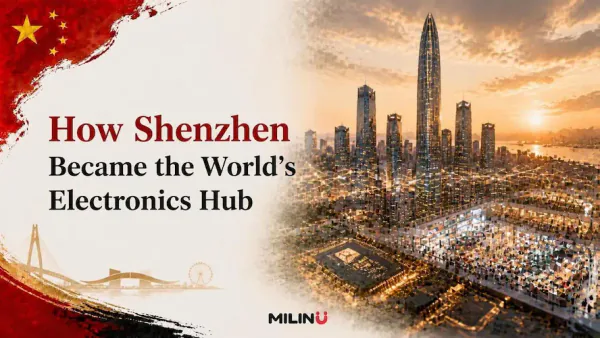
Shenzhen’s rise was not accidental. Special-zone policy, export manufacturing, and a dense supplier network turned a small southern city into a global electronics hub.
Shenzhen is often described as if it appeared overnight. The real story is longer: policy opened the door, factories filled the space, and a market for parts and products grew until the city became one of the main nodes in global electronics.
From border town to Special Economic Zone
Before the reform era, Shenzhen was a small settlement near Hong Kong, not a technology capital. The turning point came when China designated it a **Special Economic Zone (SEZ)** at the start of the 1980s. The zone was designed to attract investment, test market-oriented rules, and connect to international trade—especially through its proximity to Hong Kong.
That status mattered more than any single company. It signaled that export manufacturing, foreign partnerships, and faster commercial practice were allowed to take root in one concentrated place.
Contract manufacturing and the first wave
In the 1980s and 1990s, much of Shenzhen’s growth came from **processing and assembly**: taking components and designs, assembling them, and shipping finished or semi-finished goods abroad. The city learned electronics from the factory floor up—quality control, logistics, and volume—before it became famous for startups and brands.
This phase built skills and supplier relationships. Once assembly lines were dense enough, traders and small workshops clustered nearby. That clustering is still visible in districts where components, cables, boards, and accessories change hands every day.
Why electronics concentrated here
Several forces reinforced each other:
**Geography**
Close to Hong Kong’s port, finance, and international buyers, Shenzhen could plug into export routes earlier than many inland cities.
**Policy and infrastructure**
SEZ rules, later industrial parks, and continuous investment in transport and power made large-scale manufacturing feasible.
**Supplier density**
As more factories arrived, so did PCB shops, tooling, packaging, and component traders. Density lowered cost and lead time—the core advantage buyers still care about.
**Demand feedback**
Global demand for consumer electronics in the 2000s and 2010s rewarded regions that could scale quickly. Shenzhen was already set up to answer that demand.
From “factory city” to hardware ecosystem
Over time the mix shifted. Shenzhen remained a manufacturing base, but it also became a place where:
• engineers and trading companies sit close to production
• prototypes can be turned around quickly
• consumer gadgets, IoT devices, and accessories move from idea to sample in short cycles
Markets such as **Huaqiangbei** became symbols of that ecosystem: not the whole industry, but a visible layer of the parts-and-products trade that grew alongside formal factories.
Companies and brands did not all start equal. Some began as contract manufacturers; others as traders; a smaller set built recognizable product brands. The important pattern is the **ecosystem**, not one logo: when design, parts, and assembly share one metro area, electronics businesses form faster than in cities where each step is far apart.
What “global hub” means in practice
Calling Shenzhen a world electronics hub does not mean every advanced chip is designed there. It means that for a huge share of **commercial hardware**—devices, modules, accessories, and assembly—the city is still where capacity, speed, and price discovery meet.
Global brands and anonymous white-label products both pass through supply chains that touch South China. That is the practical definition of a hub: if you need volume, variety, or a fast second sample, this is still one of the first places the industry looks.
Lessons from the path
1. **Policy created space; markets filled it.** The SEZ did not invent electronics, but it allowed electronics trade and manufacturing to concentrate.
2. **Assembly came before brand stories.** Skills and supplier networks were built on production, not only on marketing.
3. **Density is the moat.** The hardest thing for rivals to copy quickly is not one factory—it is thousands of linked suppliers.
4. **The hub keeps evolving.** Higher costs and geopolitics push some diversification (“China + 1”), yet the accumulated ecosystem does not disappear in a single cycle.
Bottom line
Shenzhen became a global electronics hub through special-zone policy, export manufacturing, and decades of supplier concentration around assembly and trade. The skyline is new; the industrial logic is cumulative. For buyers and builders, that history explains why the city still sits at the center of so many hardware conversations.
This article is for general information only. Industrial structure and company fortunes change; treat it as orientation, not a forecast.china
Share this post
Comments
Loading comments...