
China’s Economic Outlook to 2030: Growth, Risk, and What to Watch
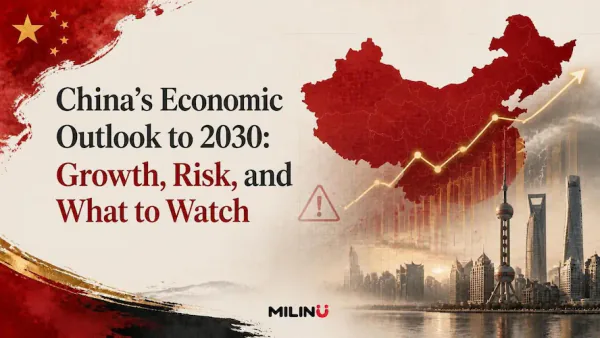
China’s path to 2030 points to slower but still significant growth, driven by technology, green industry, and domestic demand. Demographics, debt, and geopolitics are the main risks shaping trade and supply chains worldwide.
China’s next decade will matter far beyond its borders. By 2030, the country is expected to remain one of the largest engines of global demand, manufacturing, and investment—even if its growth rate is slower than in the 2000s and 2010s. For readers following trade, supply chains, and emerging markets, the real question is not whether China grows, but how the quality of that growth changes.
From high speed to high quality
For years, China prioritized rapid expansion: factories, infrastructure, and exports. The policy conversation has shifted toward “high-quality development”—more productivity, cleaner industry, stronger domestic demand, and less reliance on debt-heavy property cycles. Official planning documents and long-term goals (including modernization targets around mid-century) frame 2030 as a milestone on that path, not a finish line.
You can follow macro indicators and country analysis through sources such as the World Bank’s China overview and the IMF’s China page.
What is likely to drive growth
Several forces are expected to shape the economy through 2030:
• Technology and advanced manufacturing. Semiconductors, EVs, batteries, industrial software, and automation remain strategic priorities. Success here supports exports and reduces dependence on foreign high-tech inputs.
• Green transition. Renewables, grid upgrades, and cleaner transport are both climate policy and industrial policy. China is already a major producer of solar, wind, and EV-related equipment; that capacity can stay a growth pillar if global demand holds.
• Domestic consumption. A larger middle class and services sector can offset weaker investment in some traditional heavy industries—if household confidence and social safety nets improve.
• Urbanization and infrastructure—but more selectively. Mega-projects are less likely to be the single growth engine; efficiency and returns on capital matter more than before.
Demographics: the quiet constraint
China’s working-age population trends and low fertility are a structural headwind. Fewer young workers can mean tighter labor markets in some regions, higher wages in skilled sectors, and more pressure to automate. That does not stop growth, but it changes the growth model: productivity must do more of the work that a expanding workforce once did.
National population and related statistics are published by China’s National Bureau of Statistics.
Trade and the global system
By 2030, China will likely still be central to global supply chains—especially in electronics, machinery, green tech, and intermediate goods. At the same time, many companies will keep a “China + 1” approach: staying in China for scale and capability while adding capacity in Southeast Asia, India, or elsewhere for risk management.
Trade tensions, export controls, and industrial subsidies will continue to influence which sectors expand fastest. For global firms, the practical takeaway is diversification without assuming a full exit from the Chinese market.
Key risks to watch
A balanced 2030 outlook has to include downside scenarios:
• Property and local-government debt. A long adjustment in real estate can weigh on confidence, banking, and local finances.
• Geopolitics and technology restrictions. Limits on advanced chips, tools, or market access can slow some high-tech goals.
• Weak household demand. If consumers stay cautious, the shift toward consumption-led growth will be slower.
• Climate and resource stress. Extreme weather, energy security, and water constraints can raise costs and disrupt output.
None of these risks mean stagnation by default—but they explain why forecasts for China in 2030 usually show moderate growth, not a return to double-digit rates.
What it means for businesses and readers
If you sell into China, source from China, or compete with Chinese manufacturers, 2030 planning should focus on:
- Sector detail, not only national GDP. EVs, renewables, and advanced manufacturing may look very different from traditional property-linked industries.
- Supply-chain resilience. Dual sourcing and clearer inventory strategy matter as much as unit cost.
- Policy signals. Industrial catalogs, five-year plans, and regulatory campaigns often move markets faster than quarterly GDP prints.
- Data hygiene. Use primary statistical releases and major institution reports; avoid single viral claims about “collapse” or “inevitable dominance.”
China’s economy in 2030 is best described as larger, more tech-intensive, and more constrained by demographics and geopolitics than in the past boom years. Growth may be slower, but absolute scale—and influence on global prices, supply chains, and green industries—will remain significant. The winners will be those who track structural change, not only the headline growth number.
This article is for general information only and is not financial, investment, or legal advice. Figures and policy priorities evolve; check primary sources for the latest official data.
Comments
Loading comments...