
China’s Economy in 2020: Shock, Recovery, and What Changed
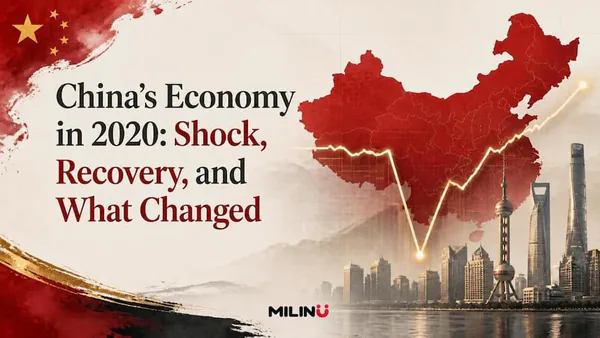
In 2020, China’s economy lived two stories at once: a sharp stop when COVID-19 hit, and a faster rebound than most major economies. Understanding that year still helps explain today’s trade patterns, supply chains, and policy debates. A year that started in lockdown
In 2020, China’s economy lived two stories at once: a sharp stop when COVID-19 hit, and a faster rebound than most major economies. Understanding that year still helps explain today’s trade patterns, supply chains, and policy debates.
A year that started in lockdown
Early 2020 brought nationwide restrictions after the outbreak in Wuhan. Factories paused, travel froze, and consumption dropped. Official data later showed China’s GDP contracted in the first quarter—rare for an economy that had grown for decades without a quarterly decline of that kind.
The shock was not only domestic. China sits at the center of global manufacturing. When Chinese plants slowed, companies worldwide felt delays in electronics, machinery, textiles, and medical goods.
Why recovery came sooner
Several factors helped China stabilize faster than many peers:
• Early and strict containment in many regions reduced prolonged stop-start cycles later in the year.
• Policy support—credit, infrastructure spending, and targeted relief—kept investment from collapsing.
• Export demand for medical equipment, remote-work devices, and consumer electronics rose as other countries stayed restricted.
• Industrial capacity allowed production to ramp once mobility improved.
By mid-to-late 2020, factory activity and exports were recovering while many advanced economies were still deep in recession.
What the numbers roughly showed
Full-year growth for China in 2020 was modest by its own history, but still positive while the global economy shrank. That gap mattered: China became an even larger share of world manufacturing output and trade flows during the pandemic period.
At the same time, the recovery was uneven. Heavy industry and exports often led; services, tourism, and small hospitality businesses recovered more slowly. Household caution also shaped consumption patterns.
Structural shifts that outlasted 2020
Beyond the GDP headline, 2020 accelerated trends that still matter:
• Supply-chain rethink: firms began diversifying suppliers (“China + 1”) without fully leaving China.
• Digital acceleration: e-commerce, logistics tech, and online services gained permanent share.
• Policy priority on security: food, energy, and tech self-reliance moved higher on the agenda.
• Global dependence: the world saw how concentrated production of key goods had become.
What it means looking back
China’s 2020 was not a smooth success story—it was a costly disruption followed by a managed rebound. The lesson for readers outside China is practical: shocks in one manufacturing hub transmit worldwide, and recovery speed depends on health policy, industrial depth, and external demand—not only on stimulus size.
For investors and operators, 2020 remains a reference point: how quickly production can restart, how exports can surge when demand shifts, and why concentration risk in supply chains is no longer theoretical.
Key takeaways
• 2020 combined a historic first-quarter shock with a relatively early industrial recovery.
• Exports and manufacturing played a larger role in the rebound than tourism-style services.
• Global firms began adjusting supply chains while still relying on Chinese capacity.
• The year’s data still inform debates on trade, resilience, and growth models.
This article is for general information and does not constitute financial advice. Economic figures should be checked against official statistical releases when precision is required.
Comments
Loading comments...